
Psalm 143:6
“I stretch forth my hands unto thee.” He was eager for his God. His thoughts of God kindled in him burning desires, and these led to energetic expressions of his inward longings. As a prisoner whose feet are bound extends his hands in supplication when there is hope of liberty, so does David. “My soul thirsteth after thee, as a thirsty land.” As the soil cracks, and yawns, and thus opens its mouth in dumb pleadings, so did the Psalmist's soul break with longings. No heavenly shower had refreshed him from the sanctuary: banished from the means of grace, his soul felt parched and dry, and he cried out, “My soul to thee;” nothing would content him but the presence of his God. Not alone did he extend his hands, but his heart was stretched out towards the Lord. He was athirst for the Lord. If he could but feel the presence of his God he would no longer be overwhelmed or dwell in darkness; nay, everything would turn to peace and joy.
Genesis 4:2
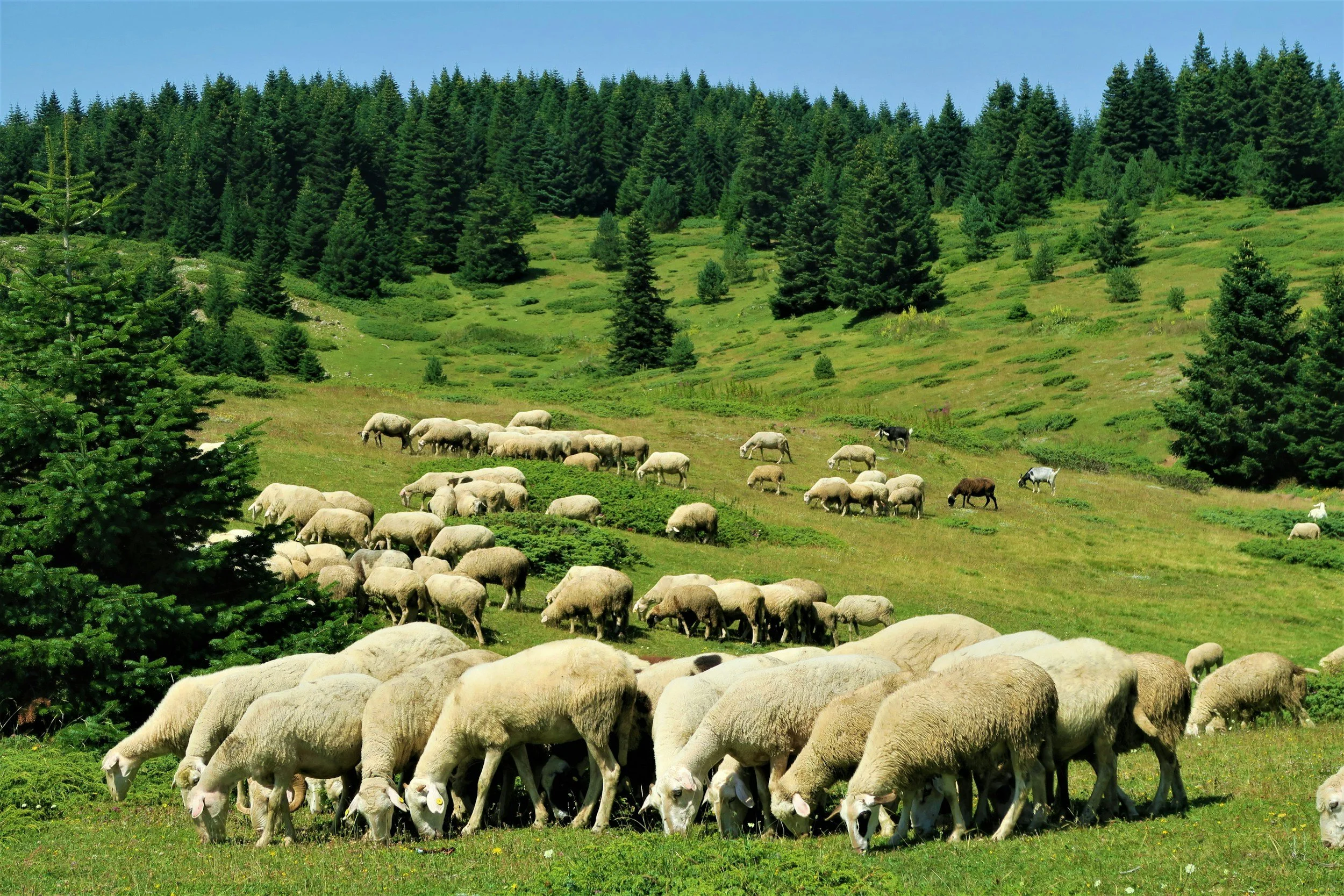
“And Abel was a keeper of sheep.” Whether both the brothers had married wives, and each had a separate home, Moses does not relate. This, therefore, remains to us an uncertainty, although it is probable that Cain was married before he slew his brother; since Moses soon after adds, that he knew his wife, and begat children: and no mention is there made of his marriage. Both followed a kind of life in itself holy and laudable. For the cultivation of the earth was commanded by God; and the labour of feeding sheep was not less honourable than useful; in short, the whole of rustic life was innocent and simple, and most of all accommodated to the true order of nature. This, therefore, is to be maintained in the first place, that both exercised themselves in labour approved by God, and necessary to the common use of human life.

Matthew 18:1-14
These words are meant for the encouragement of all true Christians, and not for little children only. The connection in which they are found with the parable of the hundred sheep and one that went astray, seems to place this beyond doubt. They are meant to show us that our Lord Jesus is a Shepherd, who cares tenderly for every soul committed to His charge. The youngest, the weakest, the sickliest of His flock is as dear to Him as the strongest. They shall never perish. None shall ever pluck them out of His hand. He will lead them gently through the wilderness of this world. He will not overdrive them a single day, lest any die. (Gen. 33:13) He will carry them through every difficulty. He will defend them against every enemy. The saying which He spoke shall be literally fulfilled: “Of them which thou gavest me have I lost none.” (John 18:9) With such a Saviour, who need fear beginning to be a thorough Christian? With such a Shepherd, who, having once begun, need fear being cast away?

Matthew 10:16-23
Let us bear this in mind continually. Whether we preach, or teach, or visit from house to house, — whether we write or give counsel, or whatever we do, let it be a settled principle with us not to expect more than Scripture and experience warrant. Human nature is far more wicked and corrupt than we think. The power of evil is far greater than we suppose. It is vain to imagine that everybody will see what is good for them, and believe what we tell them. It is expecting what we shall not find, and will only end in disappointment. Happy is that laborer for Christ, who knows these things at his first starting, and has not to learn them by bitter experience! Here lies the secret cause why many have turned back, who once seemed full of zeal to do good. They began with extravagant expectations. They did not count the cost. They fell into the mistake of the great German Reformer, who confessed he forgot at one time, that “old Adam was too strong for young Melancthon.”

Matthew 26:69-75
The first step to Peter’s fall, was self-confidence. He said, “though all men should be offended, yet will I never be offended.” — The second step was indolence. His Master told him to watch and pray. Instead of doing so, he slept. — The third step was cowardly compromising. Instead of keeping close to his Master, he first forsook him, and then “followed him afar off.” — The last step was needless venturing into evil company. He went into the priest’s palace, and “sat with the servants,” like one of themselves. — And then came the final fall, — the cursing, the swearing, and the three-fold denial. Startling as it appears, his heart had been preparing for it. It was the fruit of seeds which he himself had sown. “He ate the fruit of his own ways.”

Job 1:1-3
That he was a man who prospered greatly in this world, and made a considerable figure in his country. He was prosperous and yet pious. Though it is hard and rare, it is not impossible, for a rich man to enter into the kingdom of heaven. With God even this is possible, and by his grace the temptations of worldly wealth are not insuperable. He was pious, and his piety was a friend to his prosperity; for godliness has the promise of the life that now is.He was prosperous, and his prosperity put a lustre upon his piety, and gave him who was so good so much greater opportunity of doing good. The acts of his piety were grateful returns to God for the instances of his prosperity; and, in the abundance of the good things God gave him, he served God the more cheerfully.

Matthew 21:12-22
That fig-tree, full of leaves, but barren of fruit, was a striking emblem of the Jewish church, when our Lord was upon the earth. The Jewish church had everything to make an outward show. It had the temple, the priesthood, the daily service, the yearly feasts, the Old Testament Scriptures, the courses of the Levites, the morning and evening sacrifice. But beneath these goodly leaves, the Jewish church was utterly destitute of fruit. It had no grace, no faith, no love, no humility, no spirituality, no real holiness, no willingness to receive its Messiah. (John 1:11) And hence, like the fig-tree, the Jewish church was soon to wither away. It was to be stripped of all its outward ornaments, and its members scattered over the face of the earth. Jerusalem was to be destroyed. The temple was to be burned. The daily sacrifice was to be taken away. The tree was to wither away to the very ground. And so it came to pass. Never was there a type so literally fulfilled. In every wandering Jew we see a branch of the fig-tree that was crushed.

Matthew 21:1-11
In the first place, let us notice in these verses an example of our Lord Jesus Christ’s perfect knowledge. He sends His two disciples into a village. He tells them that they will there find the ass on which he was to ride. He provides them with an answer to the inquiry of those to whom the ass belonged. He tells them that on giving that answer the ass will be sent. And all happens exactly as He fortells.

Psalm 141:7-10
David’s case seemed hopeless: the cause of God in Israel was as a dead thing, even as a skeleton broken, and rotten, and shovelled out of the grave, to return as dust to its dust. “Our bones are scattered at the grave's mouth.” There seemed to be no life, no cohesion, no form, order, or headship among the godly party in Israel: Saul had demolished it, and scattered all its parts, so that it did not exist as an organized whole. David himself was like one of these dried bones, and the rest of the godly were in much the same condition. There seemed to be no vitality or union among the holy seed; but their cause lay at death's door. “As when one cutteth and cleaveth wood upon the earth.” They were like wood divided and thrown apart: not as one piece of timber, nor even as a bundle, but all cut to pieces, and thoroughly divided. Leaving out the word “wood,” which is supplied by the translators, the figure relates to cleaving upon the earth, which probably means ploughing, but may signify any other form of chipping and splitting, such as felling a forest, tearing up bushes, or otherwise causing confusion and division.

Matthew 26:26-35
Finally, the genius of the language in which our Lord spoke at the Lord’s Supper, makes it entirely unnecessary to interpret His words literally. The Bible is full of expression of a similar kind, to which no one thinks of giving any but a figurative meaning. Our Lord speaks of Himself as the “door” and the “vine,” and we know that he is using emblems and figures, when He so speaks. There is therefore no inconsistency in supposing that He used figurative language when He appointed the Lord’s Supper; and we have the more right to say so, when we remember the grave objections which stand in the way of a literal view of His words.

Matthew 23:34-39
There is something peculiarly deserving of notice in this expression. It throws light on a mysterious subject, and one which is often darkened by human explanations. It shows that Christ has feelings of pity and mercy for many who are not saved, and that the grand secret of man’s ruin is his want of will. Impotent as man is by nature, — unable to think a good thought of himself, — without power to turn himself to faith and calling upon God, — he still appears to have a mighty ability to ruin his own soul. Powerless as he is to good, he is still powerful to evil. We say rightly that a man can do nothing of himself, but we must always remember that the seat of impotence is his will. A will to repent and believe no man can give himself, but a will to reject Christ and have his own way, every man possesses by nature, and if not saved at last, that will shall prove to have been his destruction. “Ye will not come to me,” says Christ, “that ye might have life.” (John 5:40)

Proverbs 3:9-10
A precept which makes it our duty to serve God with our estates: Honour the Lord with thy substance. It is the end of our creation and redemption to honour God, to be to him for a name and a praise; we are no other way capable of serving him than in his honour. His honour we must show forth and the honour we have for him. We must honour him, not only with our bodies and spirits which are his, but with our estates too, for they also are his: we and all our appurtenances must be devoted to his glory. Worldly wealth is but poor substance, yet, such as it is, we must honour God with it, and then, if ever, it becomes substantial.

Genesis 3:22-23
“Behold, the man is become as one of us.” An ironical reproof, by which God would not only prick the heart of man, but pierce it through and through. He does not, however, cruelly triumph over the miserable and afflicted; but, according to the necesity of the disease, applies a more violent remedy. For, though Adam was confounded and astonished at his calamity, he yet did not so deeply reflect on its cause as to become weary of his pride, that he might learn to embrace true humility. We may add, that God inveighed, by this irony, not more against Adam himself than against his posterity, for the purpose of commending modesty to all ages. The particle, “Behold,” denotes that the sentence is pronounced upon the cause then in hand. And, truly, it was a sad and horrid spectacle; that he, in whom recently the glory of the Divine image was shining, should lie hidden under fetid skins to cover his own disgrace, and that there should be more comeliness in a dead animal than in a living man! The clause which is immediately added, “To know good and evil,” describes the cause of so great misery, namely, that Adam, not content with his condition, had tried to ascend higher than was lawful; as if it had been said, “See now whither thy ambition and thy perverse appetite for illicit knowledge have precipitated thee.” Yet the Lord does not even deign to hold converse with him, but contemptuously draws him forth, for the sake of exposing him to greater infamy. Thus was it necessary, for his iron pride to be beaten down, that he might at length descend into himself, and become more and more displeased with himself.

Psalm 148:7-10
“Beasts, and all cattle.” Animals fierce or tame; wild beasts and domestic cattle; let all these show forth the praises of Jehovah. Those are worse than beasts who do not praise our God. More than brutish are those who are wilfully dumb concerning their Maker. “Creeping things, and flying fowl.” The multitudes that throng the earth and the air; insects of every form and birds of every wing are called upon to join the universal worship. No one can become familiar with insect and bird life without feeling that they constitute a wonderful chapter in the history of divine wisdom. The minute insect marvellously proclaims the Lord’s handiwork: when placed under the microscope it tells a wonderous tale. So, too, the bird which soars aloft displays in its adaptation for an aerial life an amount of skill which our balloonists have in vain attempted to emulate. True devotion not only hears the praises of God in the sweet song of feathered minstrels, but even discovers it in the croaking from the marsh or in the buzz of “the bluefly which singeth in the window-pane.” More base than reptiles, more insignificant than insects, are songless men.

Matthew 25:31-46
All that are judged will be divided into two great classes. There will no longer be any distinction between kings and subjects, or masters and servants, or dissenters and churchmen. There will be no mention of ranks and denominations, for the former things will have passed away. Grace, or no grace, conversion or unconversion, faith or no faith, will be the only distinctions at the last day. All that are found in Christ will be placed among the sheep at His right hand. All that are not found in Christ will be placed among the goats at His left. Well says Sherlock, “Our separations will avail us nothing, unless we take care to be found in the number of Christ’s sheep, when He comes to judgment.”

Judges 6: 1-6
They let the Israelites alone to sow their ground, but towards harvest they came and seized all, and ate up and destroyed it, both grass and corn, and when they went away took with them the sheep and oxen, so that in short they left no sustenance for Israel, except what was privately taken by the rightful owners into the dens and caves. Now here we may see, [1.] The justice of God in the punishment of their sin. They had neglected to honour God with their substance in tithes and offerings, and had prepared that for Baal with which God should have been served, and now God justly sends an enemy to take it away in the season thereof…

Matthew 21:33-46
There are many hearers of the Gospel in every congregation, who are exactly in the condition of these unhappy men. They know that what they hear Sunday after Sunday is all true. They know that they are wrong themselves, and that every sermon condemns them. But they have neither will nor courage to acknowledge this. They are too proud and too fond of the world to confess their past mistakes, and to take up the cross and follow Christ. Let us all beware of this awful state of mind. The last day will prove that there was more going on in the consciences of hearers than was at all known to preachers. Thousands and ten thousands will be found, like the chief priests, to have been convicted by their own conscience, and yet to have died unconverted.

Numbers 11:31-35
What we inordinately desire, if we obtain it (we have reason to fear), will be some way or other a grief and cross to us. God satiated them first, and then plagued them, (1.) To save the reputation of his own power, that it might not be said, “He would not have cut them off had he been able to supply them.” And, (2.) To show us the meaning of the prosperity of sinners; it is their preparation for ruin, they are fed as an ox for the slaughter.

1 Kings 8:35-40
In case of public judgments, war (1 Kgs. 8:33), want of rain (1 Kgs. 8:35), famine, or pestilence (1 Kgs. 8:37), and he ends with an et cetera—any plague or sickness; for no calamity befals other people which may not befal God’s Israel. Now he supposes, that the cause of the judgment would be sin, and nothing else. “If they be smitten before the enemy, if there be no rain, it is because they have sinned against thee.” It is sin that makes all the mischief. That the consequence of the judgment would be that they would cry to God, and make supplication to him in or towards that house.

Genesis 5:29
“And he called his name Noah, saying, This same shall comfort us concerning our work.” In the Hebrew language, the etymology of the verb “nacham” does not correspond with the noun “noach” unless we call the letter “mem” superfluous; as sometimes, in composition, certain letters are redundant. “Noach” signifies to give rest, but “Nacham” to comfort. The name Noah is derived form the former verb. Wherefore, there is either the transmutation of one letter into another, or only a bare allusion, when Lamech says, “This same shall comfort us concerning our work.” But as to the point in hand, there is no doubt that he promises to himself an alleviation, or solace, of his labours. But it is asked, whence he had conceived such hope from a son whose disposition he could not yet have discerned.