
Matthew 13:24-43
The present mixed state of things is not to be for ever. The wheat and the tares are to be divided at last. The Lord Jesus shall “send forth his angels” in the day of His second advent, and gather all professing Christians into two great companies. Those mighty reapers shall make no mistake. They shall discern with unerring judgment between the righteous and the wicked, and place every one in his own lot. The saints and faithful servants of Christ shall receive glory, honor, and eternal life. The worldly, the ungodly, the careless, and the unconverted shall be “cast into a furnace of fire,” and receive shame and everlasting contempt.

Genesis 2:3
Lastly, that is a sacred rest, which withdraws men from the impediments of the world, that it may dedicate them entirely to God. But now, since men are so backward to celebrate the justice, wisdom, and power of God, and to consider his benefits, that even when they are most faithfully admonished they still remain torpid, no slight stimulus is given by God’s own example, and the very precept itself is thereby rendered amiable. For God cannot either more gently allure, or more effectually incite us to obedience, than by inviting and exhorting us to the imitation of himself. Besides, we must know, that this is to be the common employment not of one age or people only, but of the whole human race. Afterwards, in the Law, a new precept concerning the Sabbath was given, which should be peculiar to the Jews, and but for a season; because it was a legal ceremony shadowing forth a spiritual rest, the truth of which was manifested in Christ. Therefore the Lord the more frequently testifies that he had given, in the Sabbath, a symbol of sanctification to his ancient people. Therefore when we hear that the Sabbath was abrogated by the coming of Christ, we must distinguish between what belongs to the perpetual government of human life, and what properly belongs to ancient figures, the use of which was abolished when the truth was fulfilled. Spiritual rest is the mortification of the flesh; so that the sons of God should no longer live unto themselves, or indulge their own inclination. So far as the Sabbath was a figure of this rest, I say, it was but for a season; but inasmuch as it was commanded to men from the beginning that they might employ themselves in the worship of God, it is right that it should continue to the end of the world.

Psalm 147:12-20
Even to the boundaries quiet extends; no enemies are wrangling with the borders. If there is peace there, we may be sure that peace is everywhere. “When a man’s ways please the Lord he maketh even his enemies to be at peace with him.” Peace is from the God of peace. Considering the differing constitutions, conditions, tastes, and opinions of men, it is a work of God when in large churches unbroken peace is found year after year; and it is an equal wonder if worldlings, instead of persecuting the godly, treat them with marked respect. He who builds Zion is also her Peace-maker, the Lord and Giver of peace. “And filleth thee with the finest of the wheat.” Peace is attended with plenty, — plenty of the best food, and of the best sort of that food. It is a great reason for thanksgiving when men’s wants are so supplied that they are filled: it takes much to fill some men: perhaps none ever are filled but the inhabitants of Zion; and they are only to be filled by the Lord himself. Gospel truth is the finest of the wheat, and those are indeed blessed who are content to be filled therewith, and are not hungering after the husks of the world. Let those who are filled with heavenly food fill their mouths with heavenly praise.

Matthew 13:47-50
The preaching of the Gospel was the letting down of a large net into the midst of the sea of this world. The professing church which it was to gather together, was to be a mixed body. Within the folds of the net, there were to be fish of every kind, both good and bad. Within the pale of the Church there were to be Christians of various sorts, unconverted as well as converted, false as well as true. The separation of good and bad was sure to come at last, but not before the end of the world. Such was the account which the great Master gave to His disciples of the churches which they were to found.

Genesis 2:1-2
“Thus the heavens and the earth were finished.” Moses summarily repeats that in six days the fabric of the heaven and the earth was completed. The general division of the world is made into these two parts, as has been stated at the commencement of the first chapter. But he now adds, “all the host of them,” by which he signifies that the world was furnished with all its garniture. This epilogue, moreover, with sufficient clearness entirely refutes the error of those who imagine that the world was formed in a moment; for it declares that an end was only at length put to the work on the sixth day. Instead of “host” we might not improperly render the term “abundance;” for Moses declares that this world was in every sense completed, as if the whole house were well supplied and filled with its furniture. The heaven, without the sun, and moon, and stars, would be an empty and dismantled palace: if the earth were destitute of animals, trees, and plants, that barren waste would have the appearance of a poor and deserted house. God, therefore, did not cease from the work of the creation of the world till he had completed it in every part, so that nothing should be wanting to its suitable abundance.

Psalm 147:7-11
“Who covereth the heaven with clouds.” He works in all things, above as well as below. Clouds are not caused by accident, but produced by God himself, and made to assume degrees of density by which the blue firmament is hidden. A sky-scrape might seem to be a mere fortuitous concourse of vapours, but it is not so: the Great Artist’s hand thus covers the canvas of the heavens. “Who prepareth rain for the earth.” The Lord prepares clouds with a view to rain, and rain with an eye to the fields below. By many concurrent circumstances all things are made ready for the production of a shower; there is more of art in the formation of a rain-cloud and in the fashioning of a rain-drop, than appears to superficial observers. God is in the vapour, and in the pearly drop which is born of it. “Who maketh grass to grow upon the mountains.” By the far-reaching shower he produces vegetation where the hand of man is all unknown. He cares not only for Goshen’s fertile plains, but for Carmel’s steep ascents. God makes the heavens the servants of the earth, and the clouds the irrigators of the mountain meadows. This is a kind of evolution about which there can be no dispute. Nor does the Lord forget the waste and desolate places, but causes the lone hills to be the first partakers of his refreshing visitation. This is after the manner of our God. He not only causes rain to descend from the heavens to water the grass, and thus unites the skies and the herbs by a ministry of mercy; but he also thinks of the rocky ledges among the hills, and forgets not he pastures of the wilderness. What a God is this!

Matthew 13:44-46
The parable of the “treasures hid in a field,” and the “merchant man seeking goodly pearls,” appear intended to convey one and the same lesson. They vary, no doubt, in one striking particular. The “treasure” was found of one who does not seem to have sought it. The “pearl” was found of one who was actually seeking pearls. But the conduct of the finders, in both cases, was precisely alike. Both “sold all” to make the thing found their property. And it is exactly at this point that the instruction of both parables agrees.

Genesis 1:27-31
On each of the days, simple approbation was given. But now, after the workmanship of the world was complete in all its parts, and had received, if I may so speak, the last finishing touch, he pronounces it perfectly good; that we may know that there is in the symmetry of God's works the highest perfection, to which nothing can be added.

Psalm 144:12-15
Our sons are of first importance to the state, since men take a leading part in its affairs; and what the young men are the older men will be. He desires that they be like strong, well rooted, young trees, which promise great things. If they do not grow in their youth, when will they grow? If in their opening manhood they are dwarfed, they will never get over it. O the joys which we may have through our sons! And, on the other hand, what a misery they may cause us! Plants may grow crooked, or in some other way disappoint the planter, and so may our sons. But when we see them developed in holiness, what joy we have of them!

Matthew 13:1-23
The fruit here spoken of is the fruit of the Spirit. Repentance towards God, faith towards the Lord Jesus Christ, holiness of life and character, prayerfulness, humility, charity, spiritual-mindedness -- these are the only satisfactory proofs that the seed of God's word is doing its proper work in our souls. Without such proofs, our religion is vain, however high our profession. It is no better than sounding brass and a tinkling cymbal. Christ has said, “I have chosen you, and ordained you, that ye should go and bring forth fruit.” (John 15:16)

Genesis 1:26
Here he commemorates that part of dignity with which he decreed to honour man, namely, that he should have authority over all living creatures. He appointed man, it is true, lord of the world; but he expressly subjects the animals to him, because they, having an inclination or instinct of their own, seem to be less under authority from without. The use of the plural number intimates that this authority was not given to Adam only, but to all his posterity as well as to him. And hence we infer what was the end for which all things were created; namely, that none of the conveniences and necessaries of life might be wanting to men. In the very order of the creation the paternal solicitude of God for man is conspicuous, because he furnished the world with all things needful, and even with an immense profusion of wealth, before he formed man. Thus man was rich before he was born. But if God had such care for us before we existed, he will by no means leave us destitute of food and of other necessaries of life, now that we are placed in the world. Yet, that he often keeps his hand as if closed is to be imputed to our sins.

Psalm 119:169-176
The Psalmist is approaching the end of the Psalm, and his petitions gather force and fervency; he seems to break into the inner circle of divine fellowship and to come even to the feet of the great God whose help he is imploring. This nearness creates the most lowly view of himself, and leads him to close the Psalm upon his face in deepest self-humiliation, begging to be sought out like a lost sheep.

Matthew 12:1-13
Saving Christianity is closely bound up with Sabbath observance. May we never forget that our great aim should be to “keep the Sabbath holy.” Works of necessity may be done. “It is lawful to do well,” and show mercy. But to give the Sabbath to idleness, pleasure-seeking, or the world, is utterly unlawful. It is contrary to the example of Christ, and a sin against a plain commandment of God.

Genesis 1:24-25
But whence has a dead element life? Therefore, there is in this respect a miracle as great as if God had begun to create out of nothing those things which he commanded to proceed from the earth. And he does not take his material from the earth, because he needed it, but that he might the better combine the separate parts of the world with the universe itself.

Psalm 135:6-7
As a monarch is specially master of the contents of his own treasure, so is our God the Lord of the tempest and hurricane and as princes do not spend their treasure without taking note and count of it, so the Lord does not permit the wind to be wasted, or squandered without purpose. Everything in the material world is under the immediate direction and control of the Lord of all.

Matthew 9:35-38
Let us mark, in the next place, our Lord's tender concern for neglected souls. “He saw multitudes” of people when He was on earth, scattered about “like sheep having no shepherd,” and He was moved with compassion. He saw them neglected by those who, for the time, ought to have been teachers. He saw them ignorant, hopeless, helpless, dying, and unfit to die. The sight moved him to deep pity. That loving heart could not see such things, and not feel.

Genesis 1:20-23
When he says that ‘the waters brought forth,' he proceeds to commend the efficacy of the word, which the waters hear so promptly, that, though lifeless in themselves, they suddenly teem with a living offspring, yet the language of Moses expresses more; namely, that fishes innumerable are daily produced from the waters, because that word of God by which he once commanded it, is continually in force.

Psalm 114:4-6
“Ye mountains, that ye skipped like rams; and ye little hills, like lambs?” What ailed ye that ye were thus moved? There is but one reply: the majesty of God made you to leap. A gracious mind will chide human nature for its strange insensibility, when the sea and the river, the mountains and the hills, are all sensitive to the presence of God. Man is endowed with reason and intelligence, and yet he sees unmoved that which the material creation beholds with fear. God has come nearer to us than ever he did to Sinai, or to Jordan, for he has assumed our nature, and yet the mass of mankind are neither driven back from their sins, nor moved in the paths of obedience.
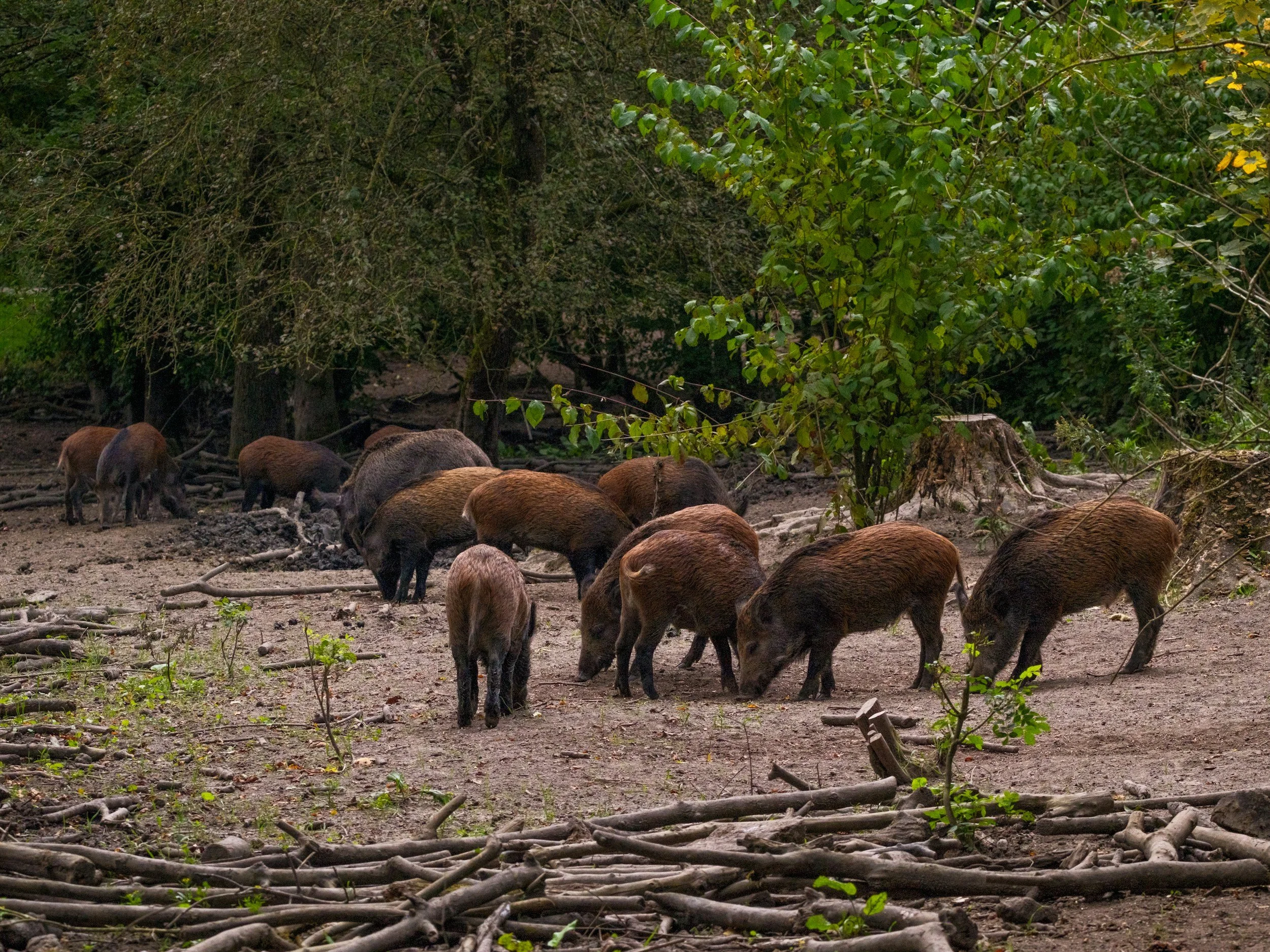
Matthew 8:28-34
Let us not leave this passage without observing the painful worldliness of the Gergesenes, among whom this miracle of casting out a devil was wrought. They ignorantly regarded Jesus as one who stood between them and their profits, and they only wished to be rid of him. There are thousands who care not one jot for Christ, or Satan, so long as they can make a little more money, and have a little more of the good things of this world. From this spirit may we be delivered!

Genesis 1:14-19
He does not ascribe such dominion to the sun and moon as shall, in the least degree, diminish the power of God; but because the sun, in half the circuit of heaven, governs the day, and the moon the night, by turns; be therefore assigns to them a kind of government. Yet let us remember, that it is such a government as implies that the sun is still a servant, and the moon a handmaid. In the meantime, we dismiss the reverie of Plato, who ascribes reason and intelligence to the stars. Let us be content with this simple exposition, that God governs the days and nights by the ministry of the sun and moon, because he has them as his charioteers to convey light suited to the season.